How to Build a Morning Routine Checklist You Will Actually Reuse
Build a short morning routine checklist that resets itself every day: what to put on it, what to leave off, and how to keep it going after a bad morning.
By Next App Factory · · 6 min read
Most people do not need a new morning routine; they need the one they already half-follow to stop depending on memory. A checklist takes the decisions out of the first hour of the day. You do not have to remember whether you took your vitamins or think about what comes next, and on a groggy morning you can simply follow the list.
The catch is that a checklist on paper or in a notes app is used up after one morning. You either rewrite it, untick every line by hand, or stop using it by Thursday. That is the whole reason to keep your routine in a list that resets itself.
1. Decide what belongs on the list
A good routine checklist is made of small, concrete actions that each take a few minutes. “Be healthier” is a goal; “Drink a glass of water” is a step. Aim for five to seven steps to begin with. You can always add more once the short version is automatic.
Useful steps tend to fall into four groups:
- Body: water, a stretch or short walk, a shower, a real breakfast, medication or vitamins.
- Space: make the bed, open the curtains, run the dishwasher, take out what needs to go.
- Head: a few minutes of quiet, reading, or writing down how you feel.
- Day: look at the calendar, pick the one task that matters most, check the weather.
Leave out anything that depends on a good day to happen. If a 45-minute workout only happens twice a week, it is not part of a daily checklist; give it its own list with its own schedule.
2. Put it in the order you move
Write the list in the order you actually walk through your morning: bedroom, bathroom, kitchen, front door. A list that makes you jump back and forth gets skipped. If two steps always happen together, such as breakfast and vitamins, keep them next to each other so one reminds you of the other.
Put the step you care about most in the first half of the list. Mornings get cut short from the end, not the beginning, so the important things should not be waiting at step nine.
3. Fit it to the time you really have
Add up rough minutes for each step and compare the total with the time between your alarm and when you need to leave or start work. If it does not fit, cut steps rather than planning to wake up earlier. A routine that needs an extra 30 minutes you do not have will fail on the first late night.
| Step | Rough time |
|---|---|
| Glass of water, make the bed | 3 minutes |
| Stretch | 5 minutes |
| Shower and get dressed | 15 minutes |
| Breakfast and vitamins | 15 minutes |
| Review today’s plan | 5 minutes |
| Total | About 45 minutes |
4. Make it reset by itself
The most important step is the least exciting one: the list has to be ready again tomorrow without any effort from you. In Tickloop that means setting the list to start fresh daily. Pick a reset time that suits your sleep, for example early in the morning, so a late evening still counts as the same day. Every item is unticked at that time, and the run you just finished is saved first.
If your mornings differ between workdays and weekends, make two lists: a weekday routine set to start fresh on weekdays, and a slower weekend version set to weekly on Saturday and Sunday.
5. Keep it going after a bad morning
Everyone misses mornings. The trick is not to let one missed day turn into a pile of guilt. A reset list helps here: a missed day simply starts fresh at the next reset, so there is never a backlog of unticked mornings to catch up on.
- Look at the week, not the day. Five good mornings out of seven is a routine that works.
- Have a minimum version. On a rushed day, do the top three steps and call it done.
- Edit after a week. If a step is skipped every day, move it, shrink it or delete it.
- Add one step at a time. Only add something new when the current list feels easy.
Seeing the record helps too. Tickloop’s Activity tab shows a calendar for every list that starts fresh, marking full days and partial days, which makes progress visible without turning it into a streak you are afraid to break.
Pair it with an evening routine
Many morning problems start the night before. A short evening checklist, such as setting out clothes, packing your bag and putting the phone on charge, makes the morning list shorter. Tickloop includes Evening Routine and Bedtime Routine templates for this, and a Sunday reset covers the weekly version of the same idea.
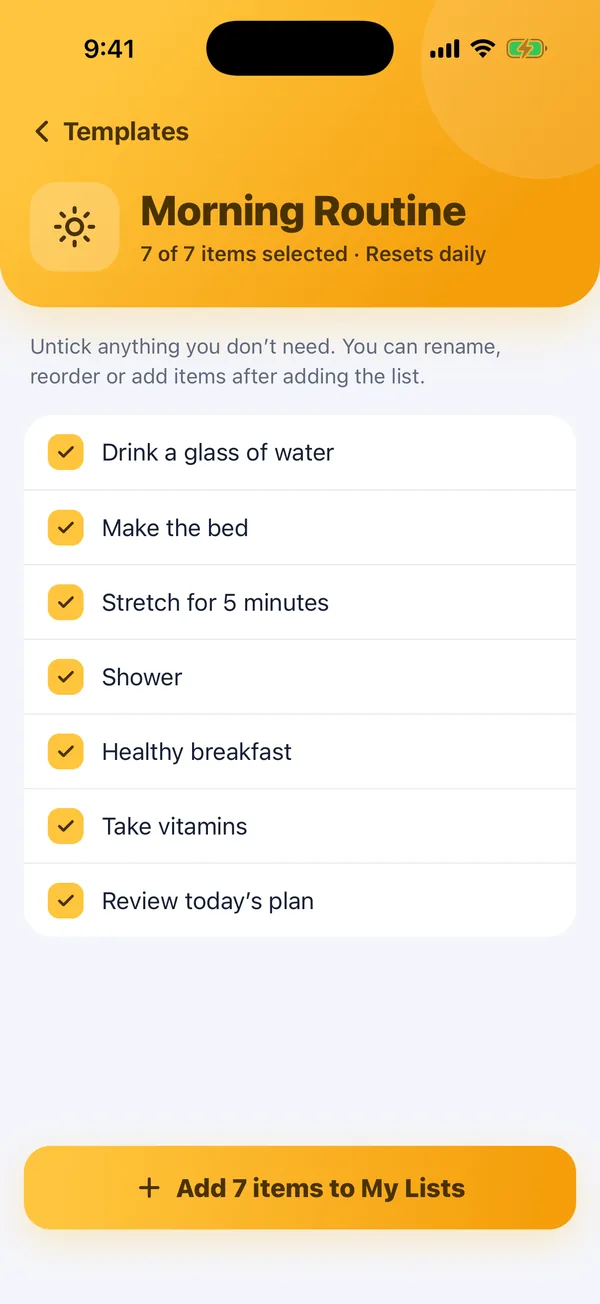
A starter morning routine checklist
- Drink a glass of water
- Make the bed
- Stretch for 5 minutes
- Shower
- Healthy breakfast
- Take vitamins
- Review today’s plan
Make it a list that starts fresh
The list above is Tickloop’s built-in Morning Routine template. Add it in one tap, untick what does not fit your mornings, and it starts fresh every day at the reset time you choose. Each morning you finished is saved in Activity, with a calendar for the month.
Tickloop is free on iPhone and Android, with no account. See how it works.